
5 Low‑Risk Ways to Use AI in Your WordPress Site This Month
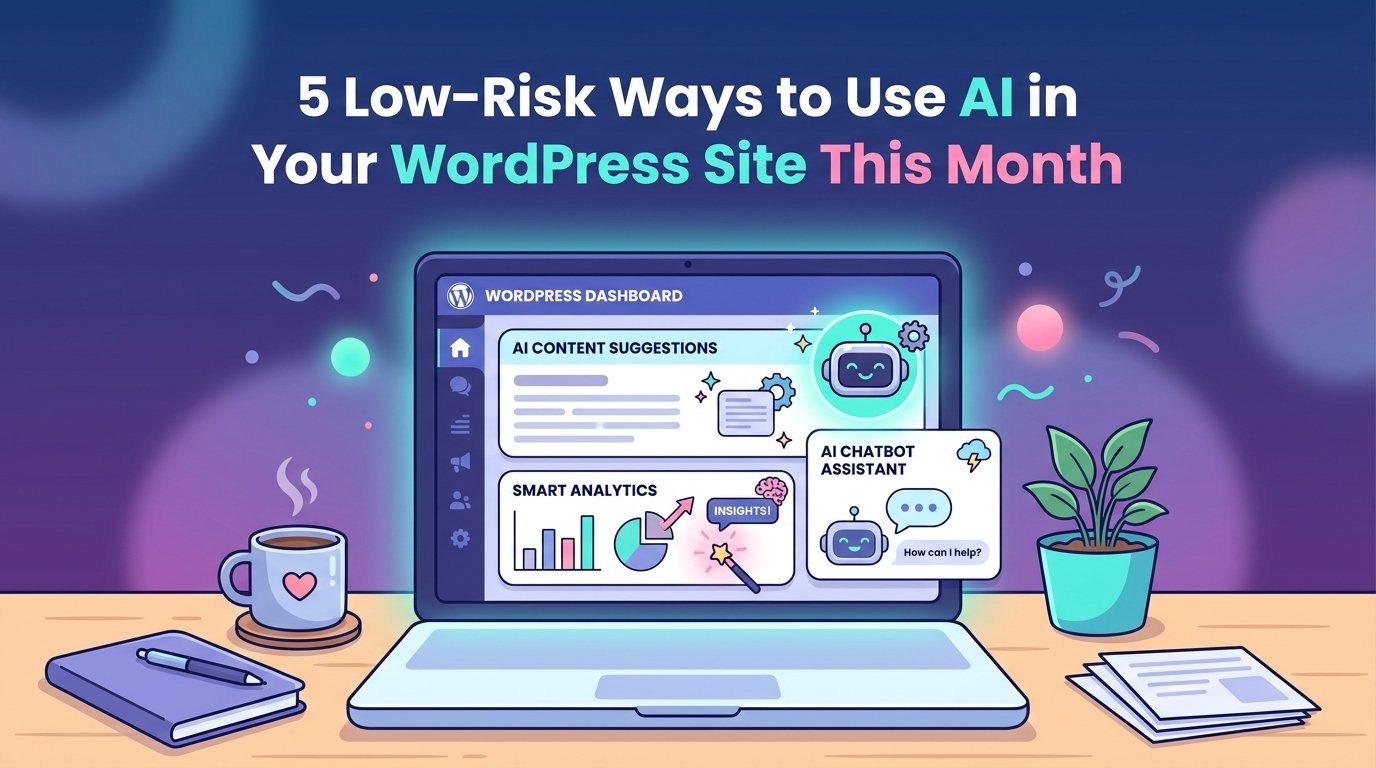
 

a cartoon theme image with a desk. On the desk is a laptop with AI content suggestions, smart analytics, and an AI chatbot assistant. Other items such as: a coffee cup, a journal and pen, a plant, and papers stacked are also present.
 
If you run a small business in a small town, you do not need flashy tech to compete. You need your phone to ring, your calendar to fill, and your website to help people trust you.
 
AI can help with that, as long as you use it in simple, low‑risk ways that do not make your site feel impersonal or break anything.
 
This guide walks through five practical upgrades you can try this month on a WordPress site, even if you are busy running the business.

Quick note: You do not have to replace your voice with AI. The goal is to save time and make it easier for local customers to find you, trust you, and contact you.

1) Turn your FAQs into a “24/7 helper” (without sounding robotic)

 
Your customers ask the same questions all the time:
  • Do you service my area
  • What does it cost
  • How soon can you get here
  • What should I do before you arrive

AI helps you write clear FAQ answers faster, but you should still review them so they match how you talk.

 
What to do this month
  • Pick 10 questions you get weekly.
  • Add an FAQ section to your most visited page.
  • Keep answers short.
  • End each answer with the next step, like “Call for a quote” or “Book online.”
 
Small‑town tip:
Add service‑area language people actually use, like nearby towns, county names, and local landmarks.

2) Write better service pages faster (and keep your local personality)

 
Most small businesses have service pages that are too thin, too generic, or missing the details locals care about.
 
AI can help you draft a solid first pass.
 
What to do this month:
 
  • Update one core service page.

Add:

  • Who the service is for
  • Common problems you fix
  • What it costs (or how pricing works)
  • What to expect next
  • 3–5 local reviews or testimonials
 

Low‑risk AI use

Use AI to create the outline and first draft. Then add your real examples and local details.

3) Improve your contact form and missed‑call follow‑up

In a small town, people often call once. If they do not hear back fast, they move on.

AI can help you tighten your contact form so you get the details you need, and it can draft quick follow‑up messages you can copy and paste.
 
What to do this month
 
  • Make sure your phone number is clickable on mobile.
  • Put your contact button at the top of every page.
 
Add 3 smart questions to your form, like:
 
  • “What town are you in?”
  • “What is the best way to reach you?”
  • “What is the main issue?”
 
Optional upgrade
 
Create 3 email templates for:
 
“We got your message”
“Here is what we need to quote you”
“Here are next available appointment times”

 

4) Add simple on‑page SEO help (titles, descriptions, and headings)

You do not need to chase complicated SEO tactics. You just need to make it obvious to Google what you do and where you do it.
 
AI can help you draft page titles and meta descriptions that are clear, not spammy.
 
What to do this month
 
  • Pick 3 pages.
 
Write:
 
  • A clear page title: “Service + Town”
  • A meta description that mentions your area and what makes you different
  • One heading that includes the service area naturally
 
Example
 
“Emergency Plumbing in Wauseon, OH: Fast Help From a Local Team”
 

5) Create a monthly “fresh content” system you can actually keep up with

 
Most small businesses do not need weekly blogging. But they do need signs of life.
 
AI can help you repurpose what you already know into something useful.
 
What to do this month
 
Choose one:
 
  • 1 short “Tip of the Month” post
  • 1 project spotlight
  • 1 seasonal checklist
 
 
Then reuse it in:
  • Your Google Business Profile
  • Facebook and Instagram
  • A short email to past customers


The safest way to use AI on your site

If you only remember one thing, make it this: use AI to speed up writing and planning, not to pretend you are someone you are not.
 
The best small‑town marketing still comes down to being clear, being helpful, and following up fast.
 

Simple next step (15 minutes)

  • Pick one page on your site that gets traffic.
  • Add one helpful section: FAQs, a clearer “How it works,” or a stronger call‑to‑action.


Want help doing this without the tech headache?

If you want, I can review your current WordPress site and give you a short, prioritized list of low‑risk updates that will help local customers find you and contact you.
 

Reply to this post in Notion with your website link and the town you want to rank in, and I will map out the next best steps.

Leave a Reply

Your email address will not be published. Required fields are marked *

Related blog POSTS

your next reading

Simple, real‑world guidance for Wauseon, Toledo, and neighboring towns—without the jargon.

Growth Mindset for Small Business Owners: How to Keep Showing Up Online

Growth Mindset for Small Business Owners:  How to Keep Showing Up Online Growth Mindset for Small Business Owners: How to Keep Showing Up Online   If you run a small business, you probably know the feeling: you’re juggling the actual work, the phone, the books, the family stuff, and then somewhere in there you’re “supposed” to post on social, keep your website fresh, and stay visible online.   This post is here to take the pressure down a notch.   A growth mindset is not about hustling harder. It’s about staying curious, staying consistent, and treating marketing like a long game you can actually keep up with.   What “growth mindset” really means (for small business owners)  A growth mindset for small business owners means:   You treat marketing as a skill you can build, not a personality trait you either have or do not have.   You expect progress to look messy at first. You measure improvement over time, not perfection today. You keep showing up, even when results are not instant.   In plain words: you do not need to be naturally “good at marketing.” You just need a plan you can stick with.   Why online visibility feels so hard (and why that’s normal) Most small business owners hit the same roadblocks:   No time: Marketing always gets pushed to “after hours.”   No clarity: You are not sure what to post, what to say, or where to focus.   No immediate payoff: You can do the right things for weeks before you feel traction.   Comparison: It looks like everyone else has it figured out.   A good growth mindset helps because it reframes visibility as a process, not a performance.   5 growth mindset shifts that make online marketing easier   1. “I’m behind” → “I’m building momentum”   Instead of treating your online presence like a scoreboard, treat it like a garden. Consistency is what compounds.   Try this: Pick one “show up” habit you can do weekly, even in a busy season.   One Google Business Profile update One short social post One photo + quick caption     2. “I need to do everything” → “I need one main lane” Trying to do Instagram, Facebook, LinkedIn, email, a blog, and SEO at the same time is how marketing becomes miserable.   Try this: Choose your primary lane for the next 90 days.    If you serve local customers: Google Business Profile + website basics first   If you serve other businesses: LinkedIn + website basics first   If you are very visual: Instagram + website basics first   You can add more later. Right now, you want something you can keep doing.     3. “My content has to be clever” → “My content has to be clear” Most clients are not looking for clever.   They are looking for:   Do you do what I need? Can I trust you? How do I contact you?     Try this: Build content around the questions people already ask you.   “How much does it cost?”   “How long does it take?”   “Do you serve my area?”   “What do you need from me to get started?”     4. “If it didn’t work, I failed” → “If it didn’t work, I learned” A growth mindset makes marketing feel less personal. A post that flops is not a character flaw. It’s data.   Try this: After you post something, write down one quick note:   What was the topic?   Did it get any saves, shares, comments, or clicks?   What would I tweak next time?   Over time, this turns into a simple system for improving.   5. “I need motivation” → “I need a routine” Motivation comes and goes. Routine is what keeps your online presence alive.   Try this: Set a “marketing minimum” you can hit even on a rough week.   Example marketing minimum:   One update on Google Business Profile One social post One website tweak or testimonial added   When you have more time, you can do more. But you never hit zero.   A simple weekly plan you can actually stick with If you want a starting point, here is a low-stress weekly rhythm:   Monday (10 minutes): Write down 3 ideas based on real client questions.   Wednesday (15 minutes): Post one tip (photo + 3–5 sentences).   Friday (10 minutes): Share one proof point (testimonial, before/after, quick story).   That is it. You are building trust and staying visible without making marketing your whole life.   When it’s time to get help (and what to ask for)   Sometimes the best “growth mindset” move is admitting what drains you. If your website is outdated, confusing, or not bringing in calls, it can make showing up online feel pointless.   A good next step is to get clarity on what matters most for your site and marketing right now:   What should your homepage say? What pages do you actually need? What are the easiest fixes that improve conversions? What should you focus on for local visibility?   Ready for clarity? If you want a simple plan for your website and online presence, let’s talk.   Schedule a Free clarity call with Day and Night Media Today!.

Read More »

When Marketing Feels Pointless: A Gentle Reset for Tired Small Business Owners

When Marketing Feels Pointless: A Gentle Reset for Tired Small Business Owners  You post.You tweak your website.You try a new idea. And still, it feels quiet. If that’s where you’re at right now, I want you to know something simple: you’re not broken, and your business isn’t doomed. Often, marketing feels pointless for one of two reasons:  You’re exhausted and running on fumes. Your marketing has drifted away from what your business actually needs right now.   This post is a gentle reset. No shame. No hustle pep talk. Just a practical way to regroup and get your next best step in front of you. 1. First: let’s name what’s really happening  When people say “marketing isn’t working,” they often mean one of these:  They’re doing a lot, but it’s scattered. A little Instagram, a little Facebook, a website that hasn’t been touched in a while, and no clear plan. They’re showing up, but not reaching the right people. The message is fine, but it isn’t clear who it’s for. They’re getting attention, but not action. People like posts, but they do not call or fill out a form. They’re comparing themselves to businesses with bigger teams, bigger budgets, or more time. That comparison will drain your motivation fast.  A reset starts with truth, not pressure. Quick check-in: Which one sounds most like you right now?  2. Take a 48-hour “marketing pause” (without disappearing)  If you’re tired, “pushing harder” is usually the worst move. Instead, take a short pause so your brain can come back online. This does not mean going silent or ghosting anyone. It means:  Stop trying to create new content for two days. Keep replying to messages and leads. Write down what you’re worried about, then set it aside.  This small pause gives you space to make smarter decisions.  3. Reconnect with your real goal (not the algorithm)  Marketing feels pointless when you’re chasing “more” instead of chasing a clear goal. Pick one goal for the next 30 days: Goal A: Get inquiries. You want calls, contact forms, and quote requests. Goal B: Build trust. You want your community to recognize you and understand what you do. Goal C: Improve conversion. You already get traffic, but it is not turning into paying work. Goal D: Create consistency. You want a sustainable rhythm you can keep up with. You can do all of these over time. You just cannot do all of them well at once.  4. Do the “three questions” reset  Grab a notebook or a note on your phone and answer these. Question 1: Who do I most want to help right now? Be specific. “Homeowners in my county with older homes” “Busy parents who need their hair done on a schedule” “Small-town business owners who want a simple, professional website”  The more specific you get, the easier your marketing becomes. Question 2: What problem are they trying to solve?  Examples:  They need a trustworthy contractor.   They need to know pricing before they call.   They need proof you are reliable and still in business.    Question 3: What is the easiest next step I want them to take? Pick one primary action: Call Fill out a form Book an appointment Get a quote Visit your shop  Marketing feels lighter when the path is simple.   5. Pick one “home base” you actually own  If you are exhausted, you do not need more platforms. You need one dependable place where people can find you even if social media changes tomorrow. For most small businesses, that “home base” is:  A simple, clear website Or a strong Google Business Profile, plus a basic website  If your website feels outdated or hard to update, you are not alone. Many business owners built something quickly years ago and never had time to refine it. A gentle reset looks like this: Make sure your phone number is easy to find. Make sure your services are clear. Make sure people can see where you work and how to contact you.  6. Create a tiny, doable marketing plan for the next two weeks  Here is a simple plan you can keep up with even when you’re busy.  Week 1: credibility and clarity  One post: “Here’s what we do and who we help.” One post: “A common question we get” (pricing, timeline, what to expect) One website tweak: Make your call-to-action clearer (call, book, contact form)   Week 2: proof and connection One post: “Before and after” or “A recent project” One post: “A mistake to avoid” (something you see clients do) One website tweak: Add 3 FAQs, or refresh your homepage headline That’s it. No 30-day content calendar. No daily posting. Just a steady, realistic reset.  7. If you are still stuck, borrow a little structure  Sometimes marketing feels pointless because you are trying to do it alone in your head. If you want support, here are two simple ways to get traction fast:  Get a quick website check: Is it clear, fast, and easy to contact you?   Get a basic plan: What to post, what to fix on your site, and what to prioritize for the next month. A gentle reminder before you go  If marketing feels pointless, it does not mean you failed. It usually means you need rest, clarity, and a smaller plan you can actually live with. You do not need to become someone else to grow your business. You just need a reset that fits your season.   Ready to feel less overwhelmed?  If you want a calm, practical reset for your website and marketing, Day and Night Media can help. If you need a quick win, start with a simple website audit and action plan. If you are ready for bigger changes, we can rebuild or refresh your site so it actually brings in inquiries. Want help figuring out your next best step? Reply to our post or reach out through our contact page, and we’ll point you in the right direction. 

Read More »

Just Sign Up for our latest- How To's, Guides, and Checklists and receive Small Biz goodies in your inbox Bi-Weekly! We Promise only Excellent content and to never spam you