
Marketing tricks that drive real sales in small towns: Google Business Profile, reviews, before/after photos, referrals, and a website that converts.

Related blog POSTS

Next Up...

Simple, real‑world guidance for Wauseon, Toledo, and neighboring towns—without the jargon.

Marketing Tricks That Actually Drive Sales Drive Leads Drive Conversions 

For Small-Town Service Businesses in Fulton County

Let’s be honest, most marketing advice on the internet wasn’t written for you.
 
It was written for e-commerce brands in Chicago, tech startups in Austin, or influencers with 100,000 followers. If you’re a plumber in Wauseon, a landscaper in Swanton, or a cleaning service in Archbold, that advice can feel like wearing someone else’s shoes. Technically functional. Completely wrong fit.
 
Small-town service businesses operate in a different world. You’re not competing for anonymous clicks, you’re competing for trust. In Fulton County, your reputation precedes every phone call. People ask their neighbors. They check Facebook before they Google. They’d rather hire someone their cousin vouched for than take a chance on a stranger with a slick ad.
 
That’s not a disadvantage. That’s your entire marketing edge, if you know how to use it.
 
Here are the marketing moves that actually move the needle when you’re running a service business in a small town.
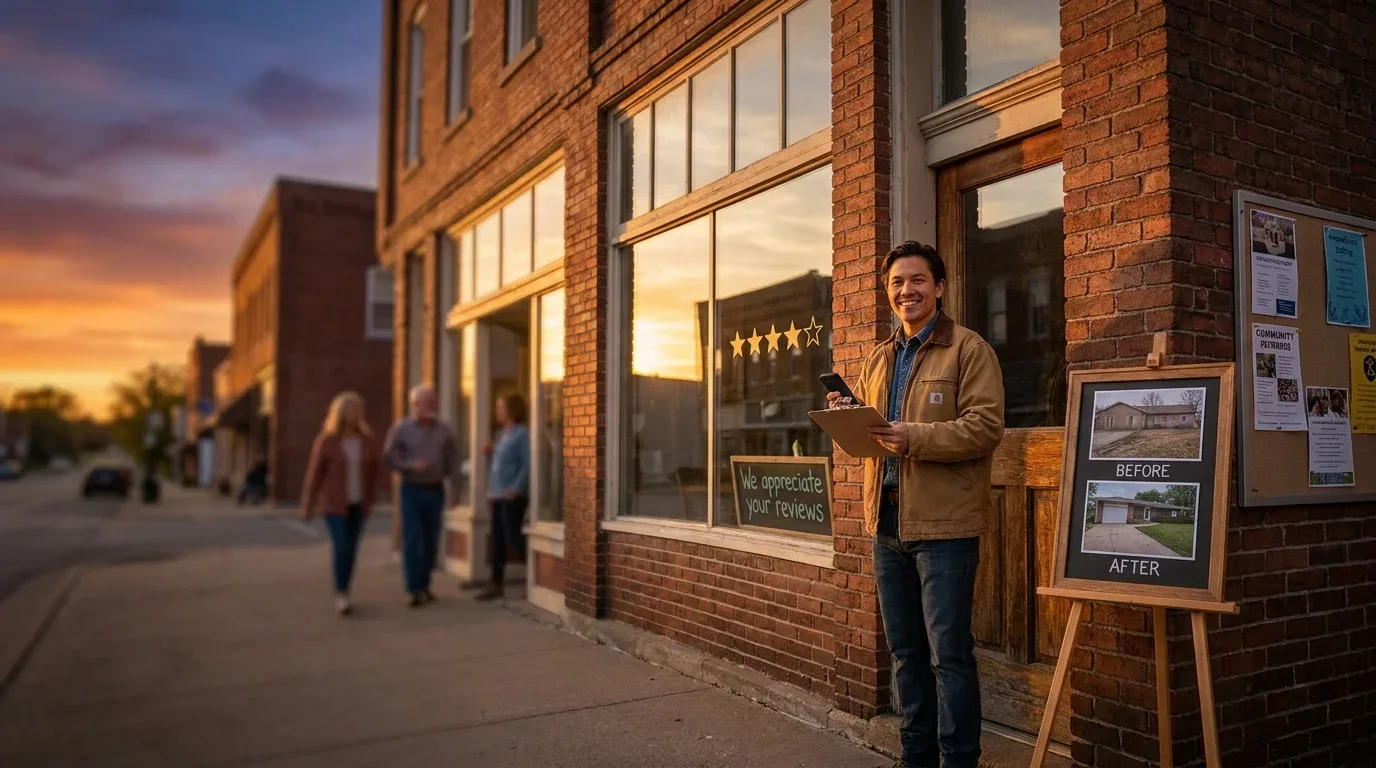
A local Business standing on main street signaling trust

1. Your Google Business Profile Is Your Most Valuable Piece of Real Estate

 
Before someone calls you, they Google you. And what they see in those first three seconds, your photos, your reviews, your hours, your location, determines whether they keep scrolling or pick up the phone.
 
If you haven’t claimed your Google Business Profile (GBP), do it today. It’s free, it takes about 20 minutes, and it is hands-down the highest-ROI thing a local service business can do. A fully optimized profile can put you above competitors who’ve been in business longer than you, just because you showed up and they didn’t.
 
What “fully optimized” actually means:
 
 
  • A complete business description with your service area and what you do
 
  • At least 10–15 real photos (your truck, your work, your team, not stock images)
 
  • Your hours updated and accurate
 
  • Responses to every single review, good or bad
 
  • Posts updated at least once a month
 
The businesses that dominate local search in small towns aren’t spending thousands on ads. They’re just the ones who treated their GBP like the front door of their business, because it is.

2. Reviews Are Your Word-of-Mouth, Scaled

 
In Fulton County, word-of-mouth has always been the currency. The difference now is that word-of-mouth happens on Google and Facebook before it happens at the gas station.
 
Five-star reviews are not just social proof, they’re an SEO signal. Google uses them to decide who shows up first. More reviews, more recent reviews, and owner responses all factor in.
 
The businesses that rack up reviews aren’t the ones with the best service (though that helps). They’re the ones who ask. Most happy customers don’t leave a review because it never crossed their mind, not because they didn’t want to.
 
Make it stupid easy:
 
 
After every completed job, send a text: “Thanks for choosing us! If we did a good job, a quick Google review means the world to us.” Include the direct link.


Put a QR code on your invoice or business card that goes straight to your review page.


Respond to every review, even the five-star ones. A simple “Thanks, it was great working with you!” shows prospects you’re a real person who cares.
 
 
One word of warning: never offer discounts or gifts in exchange for reviews. Google can remove them, and it’s not worth the risk. Just ask. Most people are happy to help if you made their life easier.

3. Show Up Where Fulton County People Already Are

 
Here’s a stat that should shift your thinking: Facebook community groups in small towns often have more daily engagement than any local business’s website. People post about lost dogs, garage sales, and, constantly, recommendations for service providers.
 
“Does anyone know a good HVAC guy?” “Who does you use for landscaping?”
 
These posts are gold, and you want to be the business that gets tagged.
 

How to position yourself:

 
  • Join every local Fulton County Facebook group you can find. Be present, be helpful, don’t spam.
 
  • When someone asks for a recommendation in your category, make sure past clients know to tag you.


Consider posting genuinely helpful content, not ads, but actual tips. “Signs your water heater is about to give out” from a local plumber is useful. People share useful things.
 
  • Don’t underestimate Nextdoor. It skews slightly older, but that’s often exactly your buyer.
 
The goal isn’t to be loud. It’s to be known, so that when someone needs what you do, your name is already in the room.

4. Before & After Content Builds Trust Faster Than Any Ad

 
You have a superpower that national brands don’t: you can show real, local work to real, local people.
 
A photo of a freshly landscaped yard in Delta hits differently than a stock photo from a corporate website. It’s recognizable. It’s proof. It’s the kind of thing people screenshot and text to their spouse.
 
Pull out your phone after every job and take two photos, before and after. That’s it. Post them on Facebook, on your Google Business Profile, on Instagram if you’re there. Tag the general area if the client allows it. “Just finished this driveway in Wauseon, couldn’t be happier with how it turned out.”
 
You don’t need professional photography. You don’t need a graphic designer. You need a clean shot in decent lighting and a caption that sounds like a real person wrote it, because you did.
 
Consistency matters more than quality here. Ten decent photos posted regularly will outperform one perfect photo posted once.

5. Referral Incentives Beat Paid Ads (At Your Stage)

 
Paid ads work. But for a local service business in year one or two, they’re usually not the best use of money. You’re paying to reach strangers when your biggest untapped asset is the customers who already love you.
 
A simple referral program changes that math fast.
 
Here’s a version that works: “Refer a friend, and if they hire us, you both get $25 off your next service.” That’s it. Print it on a card, mention it at the end of every job, put it in your follow-up text.
 
In a small town, one happy customer knows dozens of people who could use your service. A referral program turns a satisfied client into a volunteer sales rep, and that kind of lead closes at a much higher rate than a cold ad click.

6. Your Website Needs to Answer the Phone (Figuratively)

 
A lot of small-town service business websites are, frankly, letting their owners down. They exist. They have a logo and a phone number. But they’re not working.
 

Your website has one job: turn a skeptical visitor into a confident caller.

That means:

 
  • Clear headline on the homepage, what you do, who you serve, where you serve them. Within five seconds.
 
  • Social proof above the fold, a review quote, a star rating, a number of jobs completed. Something that says “real people trust us.”
 
  • One obvious call to action, a “Call Now” button or a simple contact form. Not buried in a menu. Front and center.
 
  • Mobile-optimized, 70%+ of local searches happen on a phone. If your site looks broken on mobile, you’re losing calls you never knew you had.
 
Your website isn’t a brochure. It’s a 24/7 salesperson. Treat it like one.

7. Consistency Beats Virality Every Time

 
The biggest mistake small-town service businesses make online isn’t doing the wrong things, it’s doing the right things inconsistently.
 
They post five times in a week, then go silent for two months. They collect eight reviews and stop asking. They update their Google Business Profile once and never touch it again.
 
Algorithms reward consistency. More importantly, people reward consistency. When someone sees your business show up regularly, a new review here, a before/after there, a helpful post in the community group, it creates the impression that you’re active, reliable, and busy. Busy businesses must be doing something right.
 
You don’t need to be everywhere. Pick two channels, Google Business Profile and Facebook, most likely, and commit to showing up on both, every single week. A 30-minute Friday routine to post one update and respond to any reviews is more powerful than a marketing sprint once a quarter.
 
Small moves, made consistently, compound. That’s how small-town service businesses build unshakeable local reputations.

Ready to Put This Into Action?

You know your craft. You do good work. You just need the right systems to make sure the right people can find you, trust you, and hire you.
 
That’s exactly what Day & Night Media was built for.
 
We work with local service businesses in Fulton County and beyond, building websites that convert, managing local SEO, and handling the digital side of your business so you can focus on the work you’re actually good at.
 
No jargon. No giant agency retainers. Just honest strategy that fits where you are right now.
 
Because your reputation deserves a digital presence that matches it.

a tv monitor sitting on desk with the words cosmic growth and Day and Night Media's brand with a keyboard

Local SEO vs Social Media: Where Should a Wauseon Business Start?

Local SEO vs. Social Media: Where Should a Wauseon Business Start? The short answer (for busy owners) If you are a Wauseon-area business and you want leads from people who are ready to buy, start with Local SEO first. If you need awareness fast, have a very visual product, or you are building a personal brand, add social media next. Why this question matters in Wauseon Most local customers are not scrolling social hoping to find a plumber, dentist, HVAC company, or boutique. They usually: Google it Check the map results Read a few reviews Call the one that feels trustworthy That means: if you are not showing up in Google Maps, you are invisible to high-intent customers. Local SEO vs. Social Media: what each one does best Category Local SEO (Google + Maps) Social media (Facebook/Instagram) Best for People actively searching for a service Staying top-of-mind and building trust over time Speed Medium (weeks to months) Fast to start, but results can be inconsistent Longevity High (good SEO keeps working) Lower (posts expire quickly) Consistency needed Moderate (monthly maintenance) High (ongoing posting + engagement) What drives calls Map visibility, reviews, clear service pages Offers, DM conversations, retargeting ads A simple rule of thumb If you hear, “I found you on Google,” prioritize Local SEO. If you hear, “My friend shared your post,” prioritize social.   Where most Wauseon businesses should start (recommended) Get your Google Business Profile (GBP) solid Correct category Services filled out Photos updated Hours accurate A simple review request process Fix your website basics Clear service pages Fast loading Mobile-friendly Contact button easy to tap City and service area mentioned naturally (Wauseon + surrounding towns you serve) Add a light, consistent social plan 1 to 3 posts per week Mostly proof and trust: projects, before/after, testimonials, team, behind-the-scenes   If you only have 5 hours to work on marketing this month 3 hours: Google Business Profile + reviews 2 hours: one strong website page (your main service)   If you have $300 to $1,000/month to invest Local SEO foundation first Then simple paid boosts: Google Local Services Ads or search ads (if it fits your industry) Facebook retargeting (show ads to people who already visited your site)   Common mistakes (and how to avoid them) Posting on social with no clear next step → Add a phone number, link, or “Call/Text us” CTA. Ignoring reviews → Reviews are a ranking factor and a trust factor. One big burst of content, then nothing → Pick a sustainable cadence. No tracking → At minimum: website form submissions, calls, and where leads came from.   What done looks like (30-day starter plan) [ ] Google Business Profile updated and fully filled out [ ] 10 new photos added [ ] 5 new reviews requested (and responded to) [ ] One “money page” improved on the website [ ] 4 social posts scheduled (1/week)   If you want a clear starting point, Day and Night Media LLC can do a quick, plain-English audit and tell you: What to fix first What will move the needle fastest in your market A simple plan you can actually keep up with   Reply with your business type and your top service, and I will tailor the recommendation.

Read More »

Landing Page vs. 5-Page Site: Which One Do You Need?

At some point in the “I need a website” conversation, someone’s going to ask you: do you want a full site, or just a landing page? If you don’t know the difference, you might guess. And the wrong guess costs money, either because you paid for more than you needed, or because you’re stuck with less than your business actually requires. Here’s a straight answer.   What’s a Landing Page? What is the difference between a Landing Page vs 5 Page Site? A landing page is a single web page built around one specific goal. There’s no navigation menu, no About page, no blog. Just one focused message, one clear offer, and one call to action. Landing pages are used for things like: A new service you’re launching A seasonal promotion A single-focus sales pitch (“Call us for a free estimate”) A lead capture (“Download this checklist”) They’re lean by design. The whole point is to remove distractions and push a visitor toward one decision. What’s a 5-Page Site? A 5-page site is your full foundational web presence. Typically it includes:   Home, who you are, what you do, why it matters About, your story, your team, what makes you trustworthy Services, what you offer and what it includes Portfolio or Testimonials, proof that you deliver Contact, how to reach you, book, or get a quote This is the baseline for most local service businesses. It gives Google enough to work with, gives visitors enough to trust you, and gives you a real place to send people when they ask “do you have a website?” So Which One Do You Actually Need? Here’s the honest answer: it depends on where your business is right now, but there’s a pattern that makes it pretty clear.   Choose a landing page if…   You’re just getting started and need something up fast You’re testing a new service before committing to it You’re running a single campaign or promotion You already have a main website and need a focused page for ads or outreach Budget is tight and a landing page gets you 80% of the result for 40% of the cost.   Choose a 5-page site if…   This is your primary web presence and you don’t have anything else You offer multiple services and customers need to understand all of them You need to build trust with people who’ve never heard of you You want to show up in local Google searches for your area You’re actively trying to grow and need a platform to grow from For most service businesses in Fulton County and NW Ohio, trades, clinics, professional services, local shops, the 5-page site is the right starting point. A landing page alone can get you leads, but it won’t build the kind of credibility that turns a cold search into a booked job. The Hybrid Worth Mentioning There’s a middle option a lot of small business owners miss: a one-page scrollable site. Think of it like a 5-page site that lives on one long page. Home → About → Services → Testimonials → Contact, all stacked vertically with a simple navigation that jumps you to each section. This works well for:   Solo operators or 1–2 person businesses Businesses with a single core service Anyone who wants a fast, professional presence without managing multiple pages It’s faster to build, simpler to maintain, and still gives Google and visitors what they need. What About SEO? This is where the landing page has a real limitation. A single-page site gives search engines very little to index. If you want to show up in Google for multiple services or multiple locations, “HVAC repair Wauseon” and “furnace installation Napoleon,” for example, you need more pages, more content, and more structure. A 5-page site (or more) gives you room to build that presence over time. A landing page doesn’t. If local search visibility is a priority, factor that into your decision. A Quick Comparison   Landing Page 5-Page Site Time to launch Fast (days) Moderate (2–4 weeks) Cost Lower Higher SEO potential Limited Strong Trust-building Minimal High Best for Single campaign or offer Full business presence Ongoing maintenance Minimal Low–moderate Not Sure Which One Fits? That’s exactly what a clarity call is for. We look at where your business is, what you’re trying to accomplish in the next 6 months, and recommend the right starting point, not the most expensive one. Compare our website packages → | Book a free clarity call → Day & Night Media builds websites and local SEO presence for small-town service businesses across Fulton County and NW Ohio. No guesswork. No overselling. Just a real digital presence that works.

Read More »

Growth Mindset for Small Business Owners: How to Keep Showing Up Online

Growth Mindset for Small Business Owners:  How to Keep Showing Up Online Growth Mindset for Small Business Owners: How to Keep Showing Up Online   If you run a small business, you probably know the feeling: you’re juggling the actual work, the phone, the books, the family stuff, and then somewhere in there you’re “supposed” to post on social, keep your website fresh, and stay visible online.   This post is here to take the pressure down a notch.   A growth mindset is not about hustling harder. It’s about staying curious, staying consistent, and treating marketing like a long game you can actually keep up with.   What “growth mindset” really means (for small business owners)  A growth mindset for small business owners means:   You treat marketing as a skill you can build, not a personality trait you either have or do not have.   You expect progress to look messy at first. You measure improvement over time, not perfection today. You keep showing up, even when results are not instant.   In plain words: you do not need to be naturally “good at marketing.” You just need a plan you can stick with.   Why online visibility feels so hard (and why that’s normal) Most small business owners hit the same roadblocks:   No time: Marketing always gets pushed to “after hours.”   No clarity: You are not sure what to post, what to say, or where to focus.   No immediate payoff: You can do the right things for weeks before you feel traction.   Comparison: It looks like everyone else has it figured out.   A good growth mindset helps because it reframes visibility as a process, not a performance.   5 growth mindset shifts that make online marketing easier   1. “I’m behind” → “I’m building momentum”   Instead of treating your online presence like a scoreboard, treat it like a garden. Consistency is what compounds.   Try this: Pick one “show up” habit you can do weekly, even in a busy season.   One Google Business Profile update One short social post One photo + quick caption     2. “I need to do everything” → “I need one main lane” Trying to do Instagram, Facebook, LinkedIn, email, a blog, and SEO at the same time is how marketing becomes miserable.   Try this: Choose your primary lane for the next 90 days.    If you serve local customers: Google Business Profile + website basics first   If you serve other businesses: LinkedIn + website basics first   If you are very visual: Instagram + website basics first   You can add more later. Right now, you want something you can keep doing.     3. “My content has to be clever” → “My content has to be clear” Most clients are not looking for clever.   They are looking for:   Do you do what I need? Can I trust you? How do I contact you?     Try this: Build content around the questions people already ask you.   “How much does it cost?”   “How long does it take?”   “Do you serve my area?”   “What do you need from me to get started?”     4. “If it didn’t work, I failed” → “If it didn’t work, I learned” A growth mindset makes marketing feel less personal. A post that flops is not a character flaw. It’s data.   Try this: After you post something, write down one quick note:   What was the topic?   Did it get any saves, shares, comments, or clicks?   What would I tweak next time?   Over time, this turns into a simple system for improving.   5. “I need motivation” → “I need a routine” Motivation comes and goes. Routine is what keeps your online presence alive.   Try this: Set a “marketing minimum” you can hit even on a rough week.   Example marketing minimum:   One update on Google Business Profile One social post One website tweak or testimonial added   When you have more time, you can do more. But you never hit zero.   A simple weekly plan you can actually stick with If you want a starting point, here is a low-stress weekly rhythm:   Monday (10 minutes): Write down 3 ideas based on real client questions.   Wednesday (15 minutes): Post one tip (photo + 3–5 sentences).   Friday (10 minutes): Share one proof point (testimonial, before/after, quick story).   That is it. You are building trust and staying visible without making marketing your whole life.   When it’s time to get help (and what to ask for)   Sometimes the best “growth mindset” move is admitting what drains you. If your website is outdated, confusing, or not bringing in calls, it can make showing up online feel pointless.   A good next step is to get clarity on what matters most for your site and marketing right now:   What should your homepage say? What pages do you actually need? What are the easiest fixes that improve conversions? What should you focus on for local visibility?   Ready for clarity? If you want a simple plan for your website and online presence, let’s talk.   Schedule a Free clarity call with Day and Night Media Today!.

Read More »

Just Sign Up for our latest- How To's, Guides, and Checklists and receive Small Biz goodies in your inbox Bi-Weekly! We Promise only Excellent content and to never spam you