
Table of Contents

Share

Recent Post

Follow Us

Like The article?

We have a lot more just for you! Subscribe  for the latest business growth insights

When Marketing Feels Pointless: A Gentle Reset for Tired Small Business Owners

 
You post.
You tweak your website.
You try a new idea.
 
And still, it feels quiet.
 
If that’s where you’re at right now, I want you to know something simple: you’re not broken, and your business isn’t doomed.
 
Often, marketing feels pointless for one of two reasons:
 
  • You’re exhausted and running on fumes.
  • Your marketing has drifted away from what your business actually needs right now.
 

This post is a gentle reset. No shame. No hustle pep talk. Just a practical way to regroup and get your next best step in front of you.

1. First: let’s name what’s really happening

 
When people say “marketing isn’t working,” they often mean one of these:
 
  • They’re doing a lot, but it’s scattered. A little Instagram, a little Facebook, a website that hasn’t been touched in a while, and no clear plan.
  • They’re showing up, but not reaching the right people. The message is fine, but it isn’t clear who it’s for.
  • They’re getting attention, but not action. People like posts, but they do not call or fill out a form.
  • They’re comparing themselves to businesses with bigger teams, bigger budgets, or more time. That comparison will drain your motivation fast.
 
A reset starts with truth, not pressure.
 
Quick check-in: Which one sounds most like you right now?
 

2. Take a 48-hour “marketing pause” (without disappearing)

 
If you’re tired, “pushing harder” is usually the worst move.
 
Instead, take a short pause so your brain can come back online.
 
This does not mean going silent or ghosting anyone. It means:
 
  • Stop trying to create new content for two days.
  • Keep replying to messages and leads.
  • Write down what you’re worried about, then set it aside.
 
This small pause gives you space to make smarter decisions.
 

3. Reconnect with your real goal (not the algorithm)

 
Marketing feels pointless when you’re chasing “more” instead of chasing a clear goal.
 
Pick one goal for the next 30 days:
 
Goal A: Get inquiries. You want calls, contact forms, and quote requests.
 
Goal B: Build trust. You want your community to recognize you and understand what you do.
 
Goal C: Improve conversion. You already get traffic, but it is not turning into paying work.
 
Goal D: Create consistency. You want a sustainable rhythm you can keep up with.
 
You can do all of these over time. You just cannot do all of them well at once.
 

4. Do the “three questions” reset

 
Grab a notebook or a note on your phone and answer these.
Question 1: Who do I most want to help right now?
Be specific.
 
“Homeowners in my county with older homes”
 
“Busy parents who need their hair done on a schedule”
 
“Small-town business owners who want a simple, professional website”
 

The more specific you get, the easier your marketing becomes.

Question 2: What problem are they trying to solve?
 
Examples:
 
  • They need a trustworthy contractor.
 
  • They need to know pricing before they call.
 
  • They need proof you are reliable and still in business.
 
 
Question 3: What is the easiest next step I want them to take?
Pick one primary action:
  • Call
  • Fill out a form
  • Book an appointment
  • Get a quote
  • Visit your shop
 
Marketing feels lighter when the path is simple.


5. Pick one “home base” you actually own

 
If you are exhausted, you do not need more platforms.
 
You need one dependable place where people can find you even if social media changes tomorrow.
 
For most small businesses, that “home base” is:
 
  • A simple, clear website
  • Or a strong Google Business Profile, plus a basic website
 
If your website feels outdated or hard to update, you are not alone. Many business owners built something quickly years ago and never had time to refine it.
 
A gentle reset looks like this:
 
Make sure your phone number is easy to find.
 
Make sure your services are clear.
 
Make sure people can see where you work and how to contact you.
 

6. Create a tiny, doable marketing plan for the next two weeks

 
Here is a simple plan you can keep up with even when you’re busy.
 
Week 1: credibility and clarity
 
One post: “Here’s what we do and who we help.”
 
One post: “A common question we get” (pricing, timeline, what to expect)
 
One website tweak: Make your call-to-action clearer (call, book, contact form)
 
 
Week 2: proof and connection
One post: “Before and after” or “A recent project”
 
One post: “A mistake to avoid” (something you see clients do)
 
One website tweak: Add 3 FAQs, or refresh your homepage headline
 
That’s it.
 
No 30-day content calendar.
 
No daily posting.
 
Just a steady, realistic reset.
 

7. If you are still stuck, borrow a little structure

 
Sometimes marketing feels pointless because you are trying to do it alone in your head.
 
If you want support, here are two simple ways to get traction fast:
 
  • Get a quick website check: Is it clear, fast, and easy to contact you?
 
  • Get a basic plan: What to post, what to fix on your site, and what to prioritize for the next month.

A gentle reminder before you go

 
If marketing feels pointless, it does not mean you failed.
 
It usually means you need rest, clarity, and a smaller plan you can actually live with.
 
You do not need to become someone else to grow your business.
 
You just need a reset that fits your season.
 

Ready to feel less overwhelmed?

 
If you want a calm, practical reset for your website and marketing, Day and Night Media can help.
 
If you need a quick win, start with a simple website audit and action plan.
 
If you are ready for bigger changes, we can rebuild or refresh your site so it actually brings in inquiries.
 
Want help figuring out your next best step? Reply to our post or reach out through our contact page, and we’ll point you in the right direction.
 

Next Up...

Related blog POSTS

Simple, real‑world guidance for Wauseon, Toledo, and neighboring towns—without the jargon.

What to Look For in a Local Digital Marketing Agency

What to Look for in a Local Digital Marketing Agency Too many small business owners hire a digital marketing agency the wrong way. They see a polished website, sit through a confident presentation, and sign a contract. Six months later, they’re still waiting for the phone to ring. The problem isn’t that agencies are dishonest. It’s that the signals business owners use to evaluate them, design quality, name recognition, a convincing pitch, have almost nothing to do with whether the agency can actually deliver results in your specific market.  So what should you look for when hiring a local digital marketing agency? The real evaluation criteria are less glamorous. They’re about local knowledge, provable skills, clear contracts, and honest reporting. This guide gives you a practical framework to vet any local marketing agency before you write a single check. Substance before salesmanship, every time.  Why local market knowledge matters more than agency size A large agency with a recognizable name is not the same as an agency that understands your community. These are completely different things. Small-town and mid-market buying behavior is relationship-first, trust-driven, and community-rooted. A national playbook built for a metro market, when applied to a local plumber in Fulton County, Ohio, will underperform every single time. Agencies that genuinely understand your market know which neighborhoods your customers come from, how they search (hyperlocal terms versus city-wide terms), and what trust signals actually matter in your area. They write content and optimize profiles in a way that resonates with real locals, not just algorithms. Ask any agency you’re vetting: can they name the specific communities they serve and explain how those markets behave differently? If the answer is vague, that’s your answer.  Some agencies build one SEO template and apply it everywhere. That approach can hold its own in large competitive markets where sheer volume covers for mediocrity. It falls apart when you need to rank for “HVAC repair near Wauseon OH” rather than “HVAC Columbus.” The right agency builds strategy around your specific geography, your specific competitors, and your actual customers, generic strategies don’t cut it in these markets. The local SEO skills your agency should prove before you sign Local digital marketing has a defined skill set. If an agency can’t demonstrate mastery of these fundamentals, nothing else in their pitch matters. Ask for specific examples of businesses they’ve moved into the local map pack, the top three Google Maps results. A credible agency shows you before-and-after screenshots with real client names, realistic timelines (map pack movement typically takes three to six months in medium-competition markets), and actual metrics from within Google Business Profile: calls generated, direction requests, and profile views. If they can’t show you that, they don’t have the core local SEO skill your business depends on. Beyond the Google Business Profile, a real local SEO agency keeps your Name, Address, and Phone data consistent across every relevant directory. They build local citations on platforms that matter in your industry and create landing pages optimized for neighborhood-level searches, not just generic city terms. When you ask how they approach hyperlocal keyword research, they should give you a specific, confident answer. Vague talk about “content strategy” without examples is a problem.  One question worth asking directly: do they use the same keyword strategy for every client, or do they build it from scratch? The answer will tell you whether they’re running a template operation or a real strategy practice. What should I look for when hiring a local digital marketing agency?  A pricing checklist  Pricing confusion is one of the most common reasons small businesses end up stuck in bad agency relationships. You don’t need to memorize every industry benchmark, but you do need to know what normal looks like. Monthly retainers are the standard model among reputable local agencies, roughly 62% use this structure according to industry surveys. Based on ranges commonly seen in mid-size markets in 2026, comprehensive local digital marketing services, typically including SEO, Google Business Profile management, and content, run roughly $1,000 to $3,500 per month for smaller scopes, and up to $5,000 or more for competitive markets with broader deliverables. Basic local SEO alone often starts around $500 to $1,500 per month. Be skeptical of very low quotes: they usually mean templated work, offshore execution, or minimal hours per month. Be equally skeptical of proposals that don’t specify deliverables. If a proposal doesn’t tell you exactly what they’ll do, you’re buying a vague promise.  A trustworthy proposal spells out what they will do each month, who will do it, and how success will be measured. It covers contract length, exit terms, and what happens to your accounts and digital assets if you leave. Your Google Business Profile, your website, your domain, and your analytics accounts should always belong to you. Any contract that places ownership of those assets with the agency is a red flag, stop the conversation immediately. The reporting and KPIs you should demand from day one An agency that can’t tell you clearly what they’re measuring, and why, is an agency that can’t be held accountable. Good reporting isn’t about dashboards filled with impressive-looking numbers. It’s about tracking outcomes that connect to your actual revenue. For local service businesses, the metrics that matter most are phone calls generated, direction requests from the Google Business Profile, and form submissions from the website. Local keyword ranking movement and cost per lead round out the picture. Vanity metrics like total impressions, social followers, and raw page views are secondary for businesses focused on leads and phone calls, they look good in a slide deck but don’t pay the bills. Your agency should report on GBP calls and direction requests every single month because these are direct signals of local buying intent. If they’re not tracking these, ask why.  A solid agency delivers a monthly report with trend analysis and plain-English commentary, not just a data dump. For active paid campaigns, weekly snapshots on lead volume and cost per acquisition are appropriate. Before you hire

Read More »
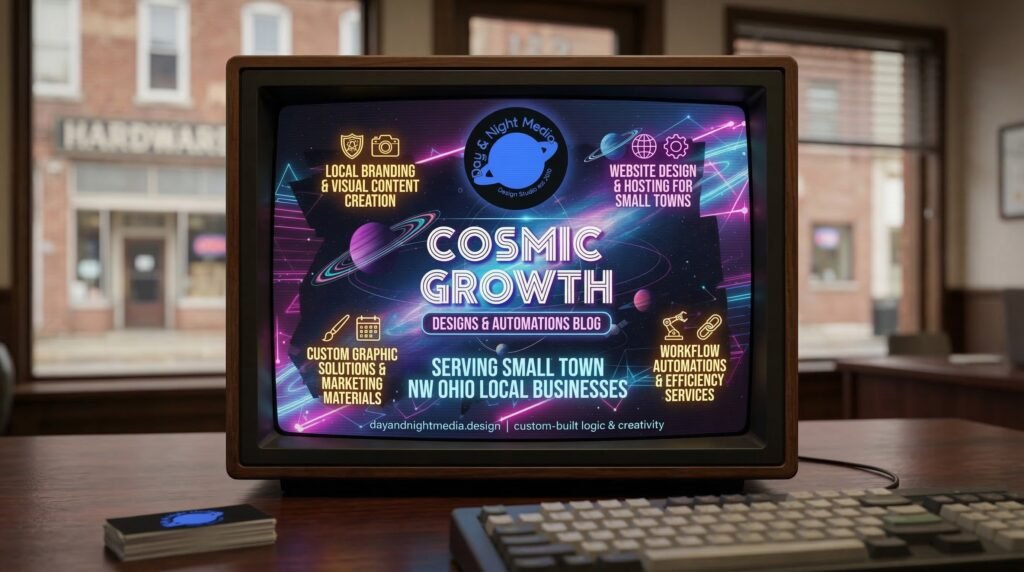
a tv monitor sitting on desk with the words cosmic growth and Day and Night Media's brand with a keyboard

Local SEO vs Social Media: Where Should a Wauseon Business Start?

Local SEO vs. Social Media: Where Should a Wauseon Business Start? The short answer (for busy owners) If you are a Wauseon-area business and you want leads from people who are ready to buy, start with Local SEO first. If you need awareness fast, have a very visual product, or you are building a personal brand, add social media next. Why this question matters in Wauseon Most local customers are not scrolling social hoping to find a plumber, dentist, HVAC company, or boutique. They usually: Google it Check the map results Read a few reviews Call the one that feels trustworthy That means: if you are not showing up in Google Maps, you are invisible to high-intent customers. Local SEO vs. Social Media: what each one does best Category Local SEO (Google + Maps) Social media (Facebook/Instagram) Best for People actively searching for a service Staying top-of-mind and building trust over time Speed Medium (weeks to months) Fast to start, but results can be inconsistent Longevity High (good SEO keeps working) Lower (posts expire quickly) Consistency needed Moderate (monthly maintenance) High (ongoing posting + engagement) What drives calls Map visibility, reviews, clear service pages Offers, DM conversations, retargeting ads A simple rule of thumb If you hear, “I found you on Google,” prioritize Local SEO. If you hear, “My friend shared your post,” prioritize social.   Where most Wauseon businesses should start (recommended) Get your Google Business Profile (GBP) solid Correct category Services filled out Photos updated Hours accurate A simple review request process Fix your website basics Clear service pages Fast loading Mobile-friendly Contact button easy to tap City and service area mentioned naturally (Wauseon + surrounding towns you serve) Add a light, consistent social plan 1 to 3 posts per week Mostly proof and trust: projects, before/after, testimonials, team, behind-the-scenes   If you only have 5 hours to work on marketing this month 3 hours: Google Business Profile + reviews 2 hours: one strong website page (your main service)   If you have $300 to $1,000/month to invest Local SEO foundation first Then simple paid boosts: Google Local Services Ads or search ads (if it fits your industry) Facebook retargeting (show ads to people who already visited your site)   Common mistakes (and how to avoid them) Posting on social with no clear next step → Add a phone number, link, or “Call/Text us” CTA. Ignoring reviews → Reviews are a ranking factor and a trust factor. One big burst of content, then nothing → Pick a sustainable cadence. No tracking → At minimum: website form submissions, calls, and where leads came from.   What done looks like (30-day starter plan) [ ] Google Business Profile updated and fully filled out [ ] 10 new photos added [ ] 5 new reviews requested (and responded to) [ ] One “money page” improved on the website [ ] 4 social posts scheduled (1/week)   If you want a clear starting point, Day and Night Media LLC can do a quick, plain-English audit and tell you: What to fix first What will move the needle fastest in your market A simple plan you can actually keep up with   Reply with your business type and your top service, and I will tailor the recommendation.

Read More »

Landing Page vs. 5-Page Site: Which One Do You Need?

At some point in the “I need a website” conversation, someone’s going to ask you: do you want a full site, or just a landing page? If you don’t know the difference, you might guess. And the wrong guess costs money, either because you paid for more than you needed, or because you’re stuck with less than your business actually requires. Here’s a straight answer.   What’s a Landing Page? What is the difference between a Landing Page vs 5 Page Site? A landing page is a single web page built around one specific goal. There’s no navigation menu, no About page, no blog. Just one focused message, one clear offer, and one call to action. Landing pages are used for things like: A new service you’re launching A seasonal promotion A single-focus sales pitch (“Call us for a free estimate”) A lead capture (“Download this checklist”) They’re lean by design. The whole point is to remove distractions and push a visitor toward one decision. What’s a 5-Page Site? A 5-page site is your full foundational web presence. Typically it includes:   Home, who you are, what you do, why it matters About, your story, your team, what makes you trustworthy Services, what you offer and what it includes Portfolio or Testimonials, proof that you deliver Contact, how to reach you, book, or get a quote This is the baseline for most local service businesses. It gives Google enough to work with, gives visitors enough to trust you, and gives you a real place to send people when they ask “do you have a website?” So Which One Do You Actually Need? Here’s the honest answer: it depends on where your business is right now, but there’s a pattern that makes it pretty clear.   Choose a landing page if…   You’re just getting started and need something up fast You’re testing a new service before committing to it You’re running a single campaign or promotion You already have a main website and need a focused page for ads or outreach Budget is tight and a landing page gets you 80% of the result for 40% of the cost.   Choose a 5-page site if…   This is your primary web presence and you don’t have anything else You offer multiple services and customers need to understand all of them You need to build trust with people who’ve never heard of you You want to show up in local Google searches for your area You’re actively trying to grow and need a platform to grow from For most service businesses in Fulton County and NW Ohio, trades, clinics, professional services, local shops, the 5-page site is the right starting point. A landing page alone can get you leads, but it won’t build the kind of credibility that turns a cold search into a booked job. The Hybrid Worth Mentioning There’s a middle option a lot of small business owners miss: a one-page scrollable site. Think of it like a 5-page site that lives on one long page. Home → About → Services → Testimonials → Contact, all stacked vertically with a simple navigation that jumps you to each section. This works well for:   Solo operators or 1–2 person businesses Businesses with a single core service Anyone who wants a fast, professional presence without managing multiple pages It’s faster to build, simpler to maintain, and still gives Google and visitors what they need. What About SEO? This is where the landing page has a real limitation. A single-page site gives search engines very little to index. If you want to show up in Google for multiple services or multiple locations, “HVAC repair Wauseon” and “furnace installation Napoleon,” for example, you need more pages, more content, and more structure. A 5-page site (or more) gives you room to build that presence over time. A landing page doesn’t. If local search visibility is a priority, factor that into your decision. A Quick Comparison   Landing Page 5-Page Site Time to launch Fast (days) Moderate (2–4 weeks) Cost Lower Higher SEO potential Limited Strong Trust-building Minimal High Best for Single campaign or offer Full business presence Ongoing maintenance Minimal Low–moderate Not Sure Which One Fits? That’s exactly what a clarity call is for. We look at where your business is, what you’re trying to accomplish in the next 6 months, and recommend the right starting point, not the most expensive one. Compare our website packages → | Book a free clarity call → Day & Night Media builds websites and local SEO presence for small-town service businesses across Fulton County and NW Ohio. No guesswork. No overselling. Just a real digital presence that works.

Read More »

Just Sign Up for our latest- How To's, Guides, and Checklists and receive Small Biz goodies in your inbox Bi-Weekly! We Promise only Excellent content and to never spam you